
- Bring your own drinks
- Alcoholic and non-alcoholic drinks provided
-

- All guests must be 21
-
Wheelchair access
- Wheelchair Accessible
This is a groupmuse
A live concert in a living room, backyard, or another intimate space. They're casual and friendly, hosted by community members.
Host
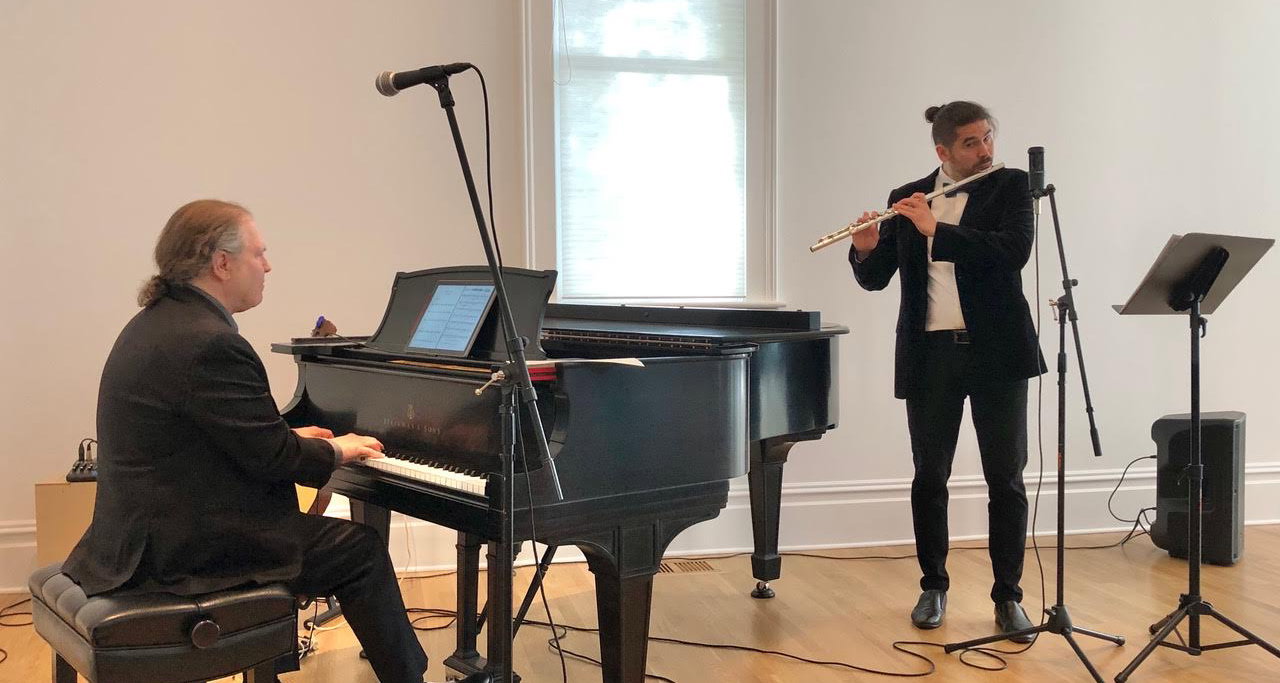
Welcome to our presentation of "Between Air and Earth" performed by Rustam Baibikov (Flutes) and David Manley (Piano)
There will be light refreshments served free of charge after the performance and opportunities to support and engage with the musicians. Come to listen and enjoy each others' company.
Full program notes
SET 1
J.S. Bach — Air from Orchestral Suite No. 3 in D Major
One of Bach’s most recognizable melodies, the Air is remarkable for its calm, flowing line and expressive simplicity. Originally written for orchestra, it creates an atmosphere of quiet reflection.
J.S. Bach — Sonata for Flute and Basso Continuo in E Major, BWV 1035
A graceful and lyrical sonata that combines elegant melodies with lively contrapuntal writing. The four movements move between tenderness, dance-like energy, and virtuosic passages.
W.A. Mozart — Fantasia No. 3 in D Minor, K. 397
A dramatic and unpredictable work that moves freely between contrasting moods. Written in the style of an improvisation, it shifts between melancholy, tension, and moments of sudden brightness.
Gabriel Fauré — Pavane, Op. 50
Originally conceived as an orchestral work, Fauré’s Pavane evokes the graceful character of an old Renaissance court dance. Its restrained melody and delicate harmonies create a sense of elegance and nostalgia.
Francis Poulenc — Sonata for Flute and Piano
Written in 1957, Poulenc’s sonata combines lyricism, humor, melancholy, and brilliant virtuosity. The music moves rapidly between intimate moments and energetic, almost theatrical passages.
SET 2
Claude Bolling — Amoureuse
Part of Bolling’s distinctive fusion of classical technique and jazz language, Amoureuse combines lyrical melodies with the rhythmic freedom and harmonic color of jazz.
Astor Piazzolla — Milonga
A refined and intimate interpretation of the Argentine milonga, a dance related to the tango. Piazzolla transforms its traditional character into something both lyrical and contemporary.
Astor Piazzolla — Sin Rumbo
Meaning “Without Direction,” the piece captures a feeling of movement and uncertainty. Its expressive melodies and characteristic tango rhythms create a sense of searching and restlessness.
Astor Piazzolla — Street Tango
A vivid expression of Piazzolla’s nuevo tango, combining the energy of traditional Buenos Aires tango with modern harmonies, rhythmic complexity, and concert-music techniques.
Manuel Ponce — Mexican Theme and Variations
Ponce draws on Mexican musical traditions and transforms a folk-like melody through a series of contrasting variations. The piece demonstrates how traditional music can become the foundation for sophisticated concert music.
Ukrainian Folk Song — Zelenée Zhito Zelene
A Ukrainian folk song associated with the imagery of green grain and the natural world. Its simple melodic character reflects the strong connection between Ukrainian folk music, landscape, and everyday life.
Tatar Folk Song — Stoneberry
A traditional Tatar melody presented through the expressive language of folk song. Its inclusion brings the program to a personal and cultural dimension, connecting the concert with the musical traditions of the Volga-Tatar region.
What's the music?
SET 1
J.S. Bach — Air from Orchestral Suite No. 3 in D Major
J.S. Bach — Sonata for Flute and Basso Continuo in E Major, BWV 1035
W.A. Mozart — Fantasia No. 3 in D Minor, K. 397
Gabriel Fauré — Pavane, Op. 50
Francis Poulenc — Sonata for Flute and Piano
SET 2
Claude Bolling — Amoureuse
Astor Piazzolla — Milonga— Sin Rumbo — Street Tango
Manuel Ponce — Mexican Theme and Variations
Ukrainian Folk Song — Zelenée Zhito Zelene
Tatar Folk Song — Stoneberry
Where does this music come from?
The two sets trace a broad musical path across three centuries and several cultural traditions.
The first set begins with J.S. Bach (1685–1750), representing the highly developed musical language of the Baroque. Bach’s music is followed by Mozart (1756–1791), whose Fantasia reflects the Classical era's interest in balance while allowing greater freedom of expression.
Fauré (1845–1924) takes the program into the French Romantic tradition. His Pavane looks backward to an imagined Renaissance past while using the refined harmonies of late-19th-century France. Poulenc (1899–1963) then brings the listener into the 20th century, combining French lyricism with modern harmony, wit, and dramatic contrasts.
The second set changes direction. Bolling brings classical musicianship into dialogue with jazz, while Piazzolla (1921–1992) radically transformed the traditional tango of Argentina into nuevo tango, incorporating elements of jazz and classical music.
Manuel Ponce (1882–1948) similarly explored the relationship between European concert traditions and Mexican folk music. The final Ukrainian and Tatar folk songs return the program to the most fundamental source of musical expression: traditional song passed through generations.
In this sense, the program is not simply a sequence of classical, jazz, tango, and folk pieces. It explores how melodies travel through time and cultures—being transformed, reinterpreted, and given new life.
Location
Exact address sent to approved attendees via email.
This is a groupmuse
A live concert in a living room, backyard, or another intimate space. They're casual and friendly, hosted by community members.
Host
Attendees


 Continue with Facebook
 Continue with Google
 Continue with Apple
Comments
Comment sections are only for participants. Please sign in and reserve a spot above to view comments.